南湖新闻网讯(通讯员 李才)近日,在国家自然科学基金项目(批准号:U22A20611、 42377321)等资助下,资源与环境学院王真教授和史志华教授团队联合国内外学者,围绕雨养农业气候韧性与水土资源可持续利用,在生产布局优化方面取得进展。相关成果以“全球雨养粮食作物生产布局优化可提升产量并降低气候风险(Global reallocation of rainfed crops can boost production and reduce climate risk)”为题发表于Nature Food。
雨养农业覆盖全球80%的耕地,贡献了60%的粮食产量,但其高度依赖自然降水,对气候变化极为敏感。在气候变化加剧的背景下,如何兼顾水土资源可持续利用,增强雨养农业的气候韧性,已成为全球粮食安全的重大挑战。为解决这一问题,研究团队融合投资组合理论和多目标规划方法,构建了全球雨养农业空间优化模型,量化气候风险,揭示了布局优化在增产和降低风险方面的潜力,进而提出兼顾水土资源可持续利用的气候韧性提升路径。
从全球治理视角出发,研究表明需因地制宜设计差异化布局优化策略,将气候韧性纳入粮食安全与水土资源管理政策,并借助生产技术与贸易政策协同,推动主要粮食生产国与消费国在气候适应型农业领域的合作。上述成果为提升全球雨养农业气候韧性、协同实现粮食安全和资源环境可持续提供了重要科学依据。
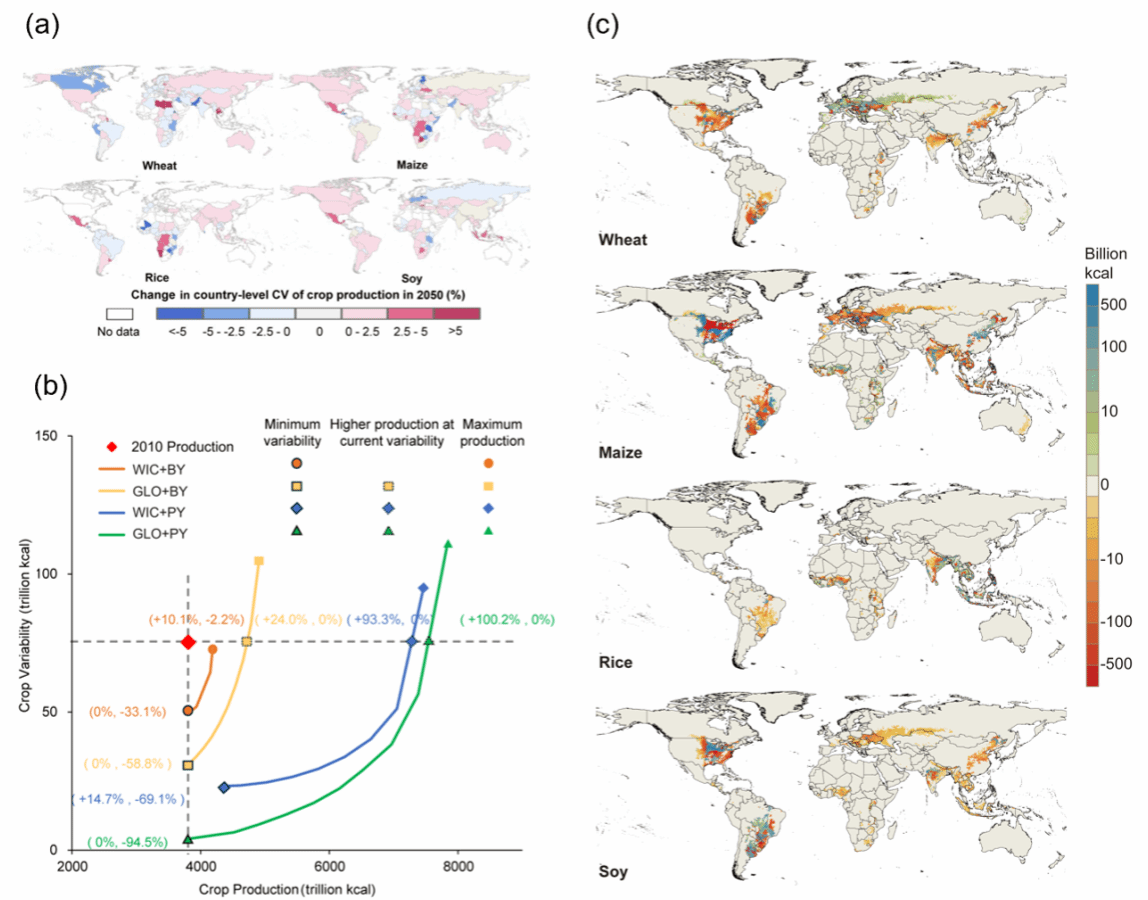
气候变化下全球雨养农业的生产风险、优化方案和布局策略
【英文摘要】
The global food system faces escalating risks to the production of major rainfed agricultural crops. Here we used modern portfolio theory to explore Pareto-optimal spatial arrangements of global rainfed cropping that explicitly account for trade-offs between total crop production and its interannual variability (risk). We analysed production/risk trade-offs under recent historical climate and yields for 2010, as well as under business-as-usual (RCP 6.0) and ambitious mitigation (RCP 2.6) climate futures for 2050. We found that optimizing the spatial distribution of rainfed crops could increase global production by 10.1% while maintaining the same level of risk as in 2010 or, alternatively, reduce production variability by 33.1% while maintaining the same level of production level as in 2010, all without additional land or water. Optimal global rainfed cropping patterns could meet future food demand with enhanced resilience under increased climate variability but only with yield-gap closure and more open and globalized trade, highlighting the need for coordinated production strategies, strengthened trade cooperation and sustainable intensification within climate adaptation policy.
论文链接:https://doi.org/10.1038/s43016-026-01365-6




 最近新闻
最近新闻