南湖新闻网讯(通讯员 李元雪)棉花作为全球最重要的天然纺织纤维来源,其产量和纤维品质对纺织产业链的稳定和升级具有重要影响。衣分(Lint percentage,LP)即籽棉中可收获纤维的重量占比,是衡量棉花产量的关键指标,长期以来在棉花驯化和高产育种中被广泛利用和选择。
衣分的高低很大程度上取决于胚珠表皮中成功起始并分化的纤维细胞数量。这一复杂的细胞命运决定过程受到包括转录调控(如MBW复合体)、激素信号(如生长素、油菜素内酯、乙烯等)以及代谢途径在内的多层级调控网络的严格控制。然而,现有关于纤维起始的研究大多聚焦于上游的转录和信号调节因子。从物理和生理角度来看,纤维起始是一个细胞极速突起和扩张的过程,伴随着诸如瞬时活性氧(ROS)积累、氧化还原稳态调节以及高效蛋白质合成和质量控制等剧烈的“发育应激”信号。目前,将这些上游调控信号直接转化为细胞物理突起的“分子执行者”仍缺乏深入解析。
近日,我校棉花遗传改良团队在国际期刊Journal of Advanced Research在线发表了题为“GhFIR_A08: An Uncharacterized Regulator Promotes Cotton Fiber Initiation by Integrating into a GhWRKY16-GhRL6 Transcriptional Hierarchy”的研究论文。该研究解析了一个结构变异介导的新基因GhFIR_A08(Fiber Initiation Regulator on chromosome A08)正向调控棉花纤维起始进而促进棉花衣分的分子机制,其鉴定获得的上下游基因及自身拷贝数变异,为棉花高产育种提供了全新视角与基因资源。
研究人员分析FIRs基因家族的进化和复制历程,发现该基因家族在全基因组加倍事件和多倍化的共同驱动下,由二倍体棉花中的两个拷贝增加至异源四倍体陆地棉中的四个拷贝。目前可用的异源四倍体棉花品种及其祖先种的高质量基因组显示,与A08不同,其他染色体上的另外3个同源基因很少发生缺失(图1A和B)。缺失断点序列比对分析表明,该缺失事件可能由Gypsy/Tekay LTR逆转座子驱动(图1C和D),左侧断点可能发生在AD2分化之前,右侧插入则可追溯至AD7和AD1分化之前(图1E)。
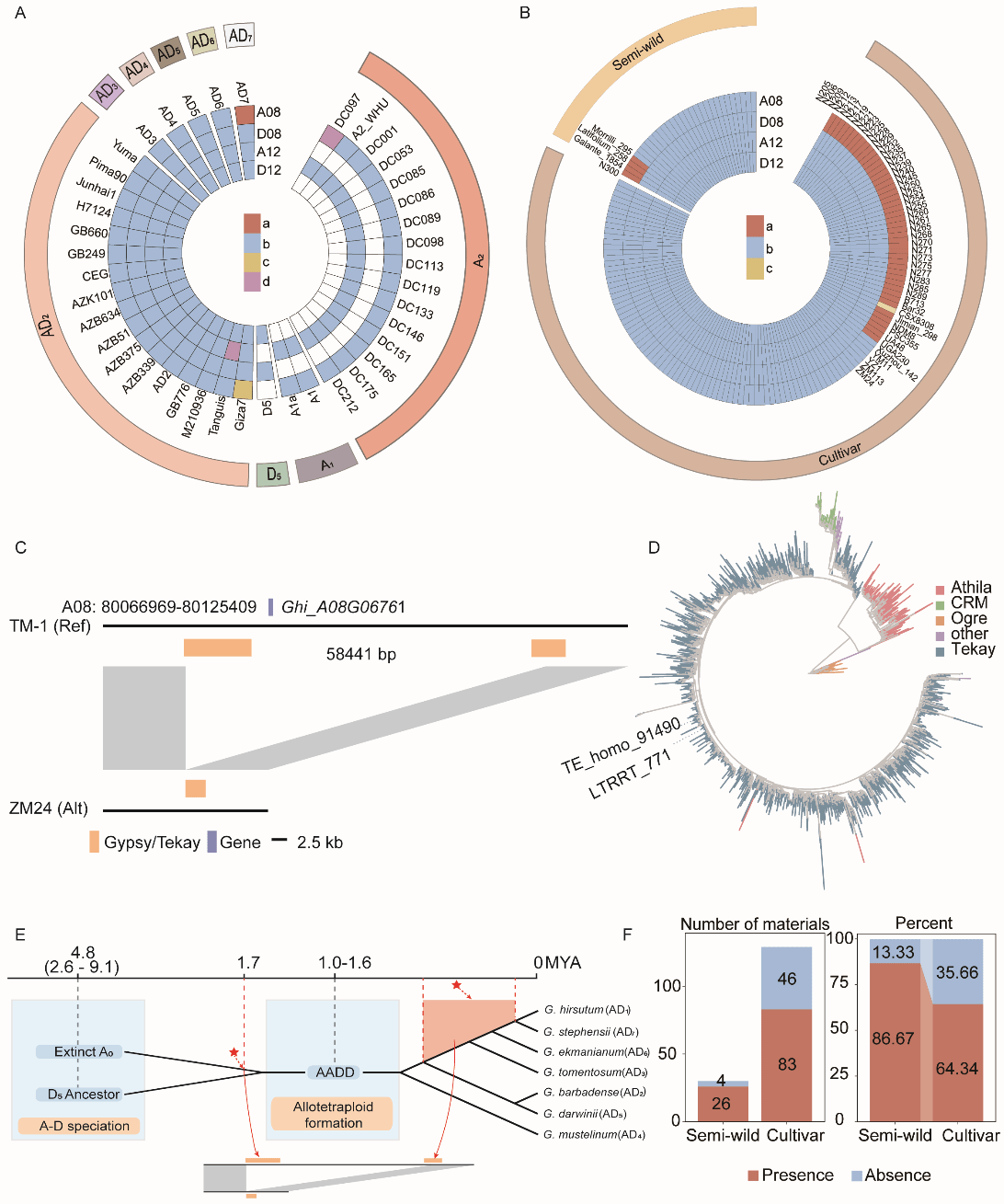
图1. GhFIR_A08缺失机制分析
研究人员发现,过量表达GhFIR_A08可以促进胚珠表面纤维突起数目,进一步提升衣分;敲除该基因,则呈现相反的趋势,说明该基因正向调控棉花纤维起始。进一步研究表明,GhWRKY16和GhRL6可以分别促进GhFIR_A08的转录激活,此外,GhWRKY16也可以作为GhRL6的上游基因发挥调控作用。据此,研究人员提出一个可能的GhWRKY16-GhRL6-GhFIR_A08层级调控网络。通过筛选棉花胚珠中潜在的互作蛋白及其下游通路,发现GhFIR_A08可与Gh14-3-3、GhSPL13、GhPPR及GhHSP70相互作用,并通过JA信号转导、氧化还原稳态及蛋白质量调控等途径参与纤维起始过程(图2)。
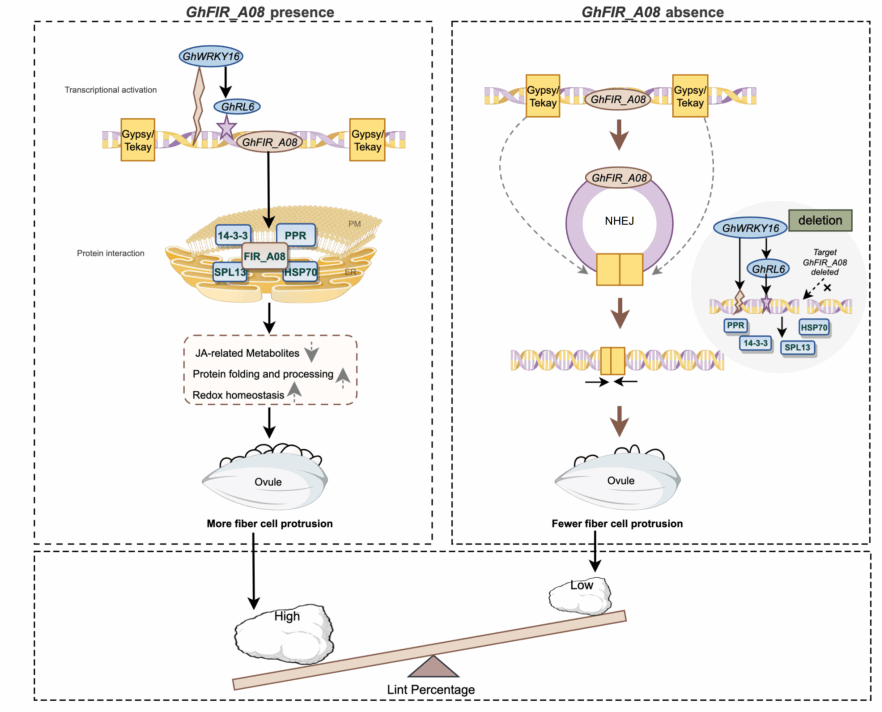
图2. GhFIR_A08调控棉花衣分的工作模型示意
综上所述,该研究不仅鉴定到GhFIR_A08正向调控棉花纤维起始和衣分,还揭示了其受转座子介导的结构变异特征及GhWRKY16-GhRL6-GhFIR_A08分子调控模块。研究成果在理论上衔接了转录调控与纤维发育执行过程,为理解结构变异驱动多倍体作物农艺性状塑造提供新的视角,并为提高皮棉产量的精准育种提供了重要分子靶点。
华中农业大学植物科学技术学院博士研究生李元雪、付超为论文共同第一作者,林忠旭教授为通讯作者,团队带头人张献龙教授参与了该研究的指导工作。该项研究得到了国家重点研发计划(No. 2022YFD1200301)的资助。
【英文摘要】
Cotton is an important global economic crop, and enhancing yield remains a primary breeding objective. Fiber development is controlled by a complex regulatory network, with the initiation stage being pivotal because it determines fiber number and ultimately yield. However, most studies have focused on upstream transcription factors, leaving downstream functional genes largely uncharacterized. To explore the gene function and regulatory network of the unannotated gene GhFIR_A08 (Fiber Initiation Regulator on chromosome A08), which was identified based on previous structural-variant analyses and highly expressed during fiber initiation. Currently high-quality Gossypium genome assemblies were compared to investigate the origin of the FIRs gene family and the mechanism of transposon-mediated copy number variation. Gene function was evaluated by generating stable homozygous transgenic lines (both knockout and overexpression) in the recipient backgrounds. Interacting proteins were screened and verified by MBP pull-down combined with mass spectrometry, yeast two-hybrid, bimolecular fluorescence complementation, and pull-down assays. The regulatory network was explored by yeast one-hybrid, dual-luciferase reporter, electrophoretic mobility shift assays, RNA-seq, and measurements of related metabolites.
Alongside the evolutionary origin and polyploidization-driven expansion of this gene family in Gossypium, a transposon-mediated, haplotype-specific loss of GhFIR_A08 was uncovered. Overexpressing GhFIR_A08 increased the number of ovule protrusions and enhanced lint percentage (LP), whereas knockout produced the opposite phenotype. An upstream regulatory hierarchy was further uncovered in which GhWRKY16 induces another activator, GhRL6; both GhWRKY16 and GhRL6 bind the respective sites of GhFIR_A08 promoter, forming a coherent GhWRKY16-GhRL6-GhFIR_A08 module to activate GhFIR_A08. Functionally, GhFIR_A08 cooperates with Gh14-3–3, GhHSP70, GhSPL13, and GhPPR to regulate cotton fiber initiation by modulating hormone signaling, protein homeostasis, and redox processes. The uncharacterized gene, GhFIR_A08 is revealed to positively regulate fiber initiation to increase LP, and provides valuable genetic resources for molecular breeding aimed at improving cotton yield.
论文链接:https://authors.elsevier.com/sd/article/S2090-1232(26)00548-5




 最近新闻
最近新闻