南湖新闻网讯(通讯员 田真)近日,果蔬园艺作物种质创新与利用全国重点实验室、湖北洪山实验室王鹏蔚教授团队在Nature Plants期刊发表了题为“Ubiquitin-dependent mitochondrial protein degradation ensures seedling emergence by regulating ER–mitochondrial interaction and mitophagy”的研究论文。该研究鉴定出定位于线粒体外膜的E3泛素连接酶SPL2,揭示了其在植物幼苗出土过程中精确调控线粒体质量控制和功能维持的关键机制,为幼苗出土机制提供了新的见解。
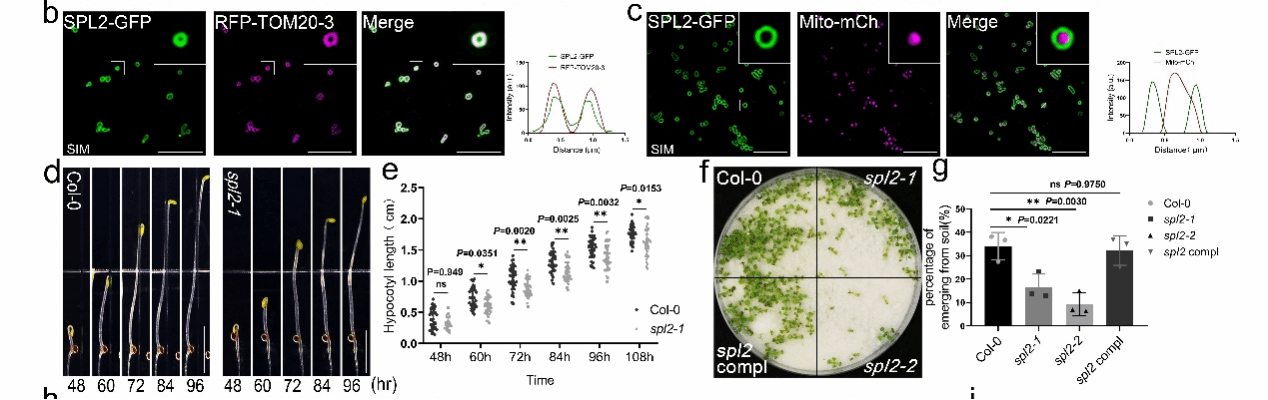
图1. SPL2定位于线粒体外膜影响幼苗破土而出
在动物细胞中,PINK1-Parkin通路是清除受损线粒体的经典途径。但植物基因组中并未发现Parkin的同源蛋白,暗示植物可能演化出独特的调控机制。研究团队发现一个定位于线粒体外膜的RING型E3泛素连接酶SPL2,其功能缺失突变体表现出下胚轴伸长速率显著降低,种子出土受阻的表型。在幼苗出土过程中,突变体中线粒体膜电位降低、数量减少、碎片化和聚集增多,证明SPL2介导的线粒体功能调控是幼苗破土而出的关键。
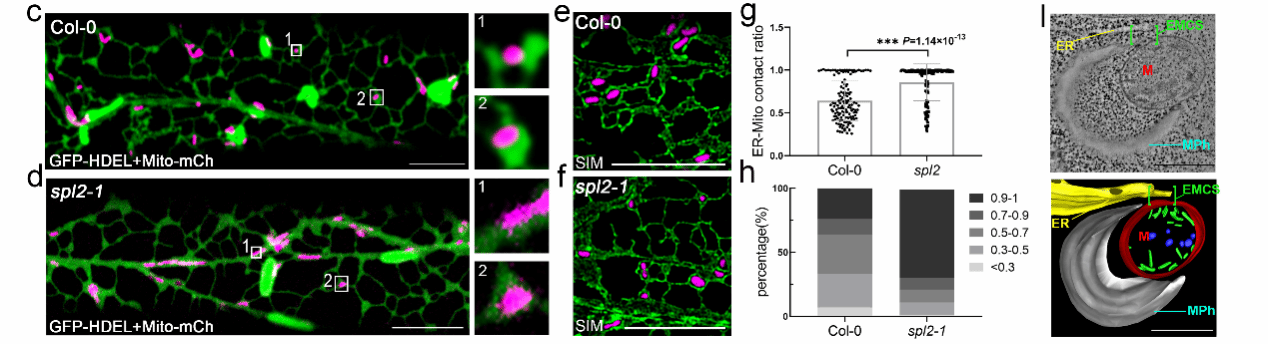
图2. SPL2影响内质网-线粒体互作以及EMCS参与启动线粒体自噬
进一步实验表明,SPL2能够直接结合并泛素化降解线粒体蛋白TRB1和FIS1A。这两种蛋白不仅定位于线粒体外膜,还能与内质网上的VAP27-1蛋白互作,三者共同组装成一个位于ER-线粒体接触位点(EMCS)的蛋白质复合物。spl2突变体表现出增加的内质网-线粒体互作,表明SPL2通过降解EMCS复合体影响内质网-线粒体互作。
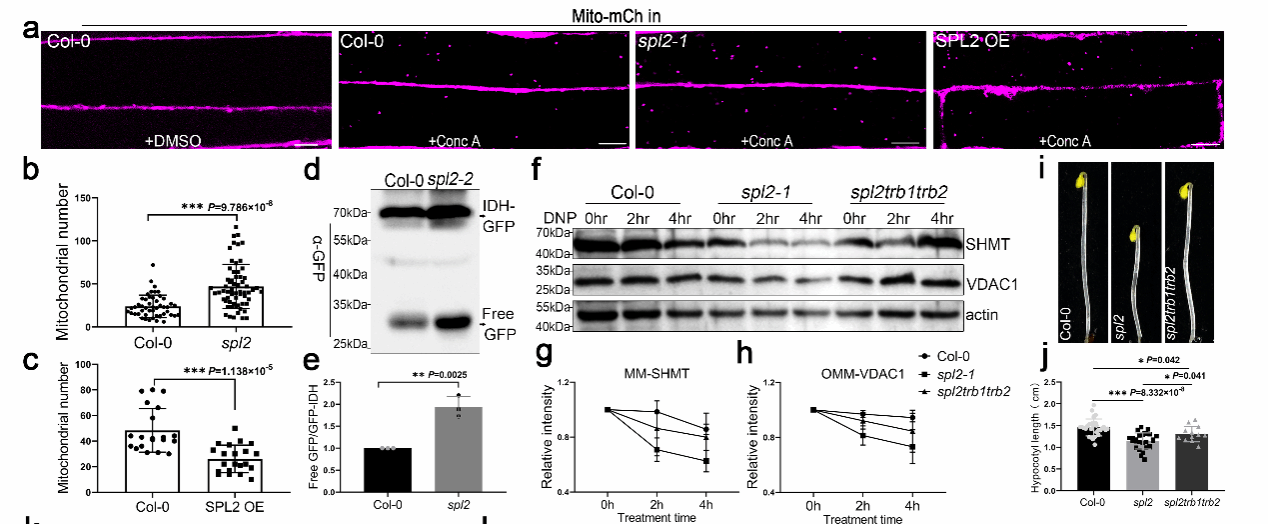
图3. SPL2调控线粒体自噬
ER-线粒体接触位点参与启动线粒体自噬,spl2突变体中线粒体自噬活性异常增强。而在SPL2过表达株系中,线粒体自噬被有效抑制。有趣的是,当在spl2背景下同时敲除TRB1和TRB2(spl2 trb1 trb2三突变体)后,过度活跃的线粒体自噬和生长缺陷均得到部分恢复,说明SPL2的调控主要通过TRB介导线粒体自噬。此外,SPL2蛋白的表达在植物感知光照后显著上调,与在光照下线粒体自噬活性降低的趋势一致,这一发现揭示了SPL2参与植物从暗土生长到见光发育转换过程中,线粒体质量控制的动态调控过程。
研究团队进一步将SPL2的同源基因在番茄和柑橘中进行了验证。结果发现,番茄SlSPL2和柑橘CsSPL2同样定位于线粒体,且番茄Slspl2 CRISPR突变体也表现出幼苗出土延迟、下胚轴变细、线粒体自噬增强等表型,表明SPL2介导的调控机制在种子植物中高度保守。
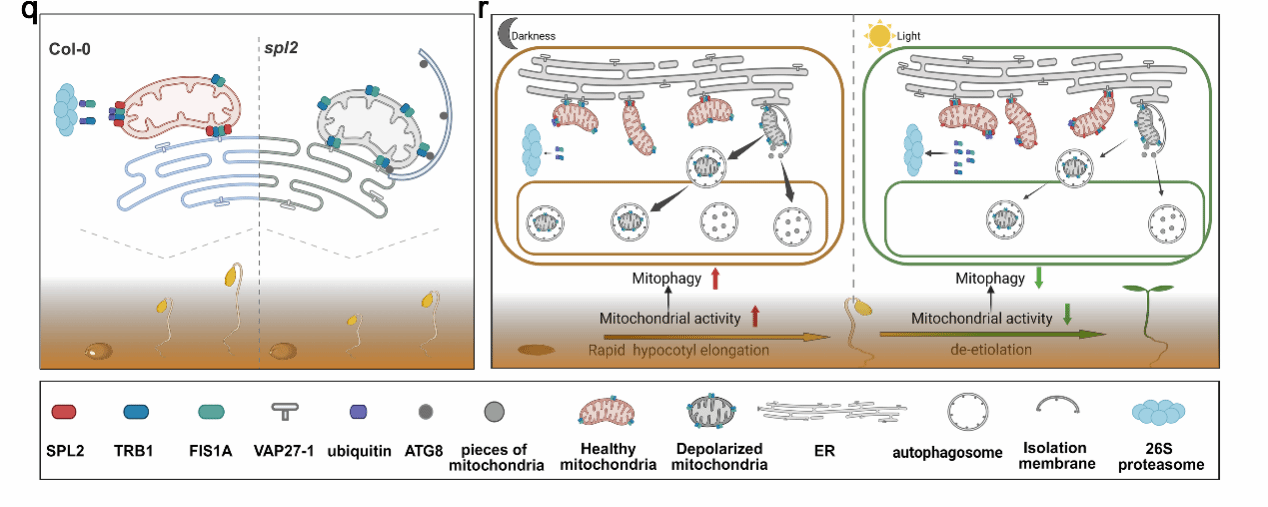
图4. SPL2调控线粒体自噬与幼苗破土而出的工作模型
综上所述,该研究将线粒体自噬、内质网-线粒体互作与泛素化降解三个层面联系起来,揭示了SPL2像一个‘能量开关’,动态平衡植物幼苗出土过程中能量供给与线粒体质量控制的分子机制,完善了植物幼苗发育的基础理论体系。
华中农业大学果蔬园艺作物种质创新与利用全国重点实验室博士后田真、博士研究生霍雅雯为论文共同第一作者,王鹏蔚教授为通讯作者。该研究得到国家自然科学基金、湖北省科技计划项目、教育部基础与交叉学科突破计划和中央高校基本科研业务费专项资金等项目的资助。
【英文摘要】
Seedling emergence is a pivotal step of plant survival, requiring rapid hypocotyl elongation for soil penetration. This energy-demanding process necessitates active mitochondrial respiration, which inevitably induces oxidative damage. Plants have therefore evolved a quality-control mechanism that selectively removes dysfunctional mitochondria through the mitophagy pathway. Here we identified SPL2, a mitochondrial E3 ligase that is essential for hypocotyl elongation and seedling emergence through degrading mitochondrial outer membrane proteins, such as TRB1 and FIS1A. Intriguingly, these proteins also interact with an endoplasmic reticulum (ER) protein, VAP27-1, forming a complex at the ER–mitochondria contact sites, which is essential for mitophagy initiation. The spl2 mutant exhibits enhanced ER–mitochondrial tethering and mitophagy activation, whereas the overexpression of SPL2 has the opposite effects. The expression of SPL2 increases after light perception, in agreement with the reduced mitophagy. Collectively, our findings reveal mechanistic insights into seedling emergence, which is coordinated through protein ubiquitination, ER–mitochondrial interaction and mitophagy.
论文链接:https://www.nature.com/articles/s41477-026-02306-8?utm_source=rct_congratemailt&utm_medium=email&utm_campaign=nonoa_20260528&utm_content=10.1038/s41477-026-02306-8
审核人:王鹏蔚




 最近新闻
最近新闻