南湖新闻网讯(通讯员 吴一超)近日,我校资源与环境学院、农业微生物资源发掘与利用全国重点实验室蔡鹏教授团队在国际土壤学领域期刊Soil Biology and Biochemistry在线发表题为“Extracellular polymeric substances: overlooked contributors to soil organic carbon persistence”的综述论文。系统阐释了土壤微生物分泌的胞外聚合物(Extracellular Polymeric Substances,EPS)在土壤有机碳形成和长期保存中的关键作用,提出EPS是连接微生物与土壤有机碳库的重要通路,并将其明确纳入土壤微生物碳泵理论框架,为重新认识微生物驱动的土壤碳循环提供了新的理论视角。
土壤有机碳是陆地上最大的碳库,是保持土壤肥力、调节全球气候、保障农业生态安全的重要物质基础。近十年,科学家用“土壤微生物碳泵”理论来解释土壤有机碳如何形成并长期保存。这个理论认为:植物产生的碳先被土壤微生物吸收,转化成微生物自身的细胞;微生物死后,其残体附着在土壤矿物上,最终变成长期稳定的土壤有机碳。不过,微生物在生长过程中还会不断向细胞外分泌一些黏性大分子物质,这些由多糖、蛋白质、脂类和核酸等组成的生物聚合物就是EPS,是微生物与土壤环境互作的直接界面。EPS不仅帮助微生物适应土壤环境,还可能是微生物向土壤持续输送碳的重要途径。
已有研究发现,用现有方法提取的EPS碳,约占农田和草地土壤有机碳的2%。但由于一部分EPS与土壤矿物结合得很紧、难以溶解,现有方法很难把它们全部提取出来,导致土壤中EPS的实际储量被明显低估。研究团队系统梳理已有研究后发现,土壤微生物合成和分泌EPS的速率,可能不低于甚至高于其细胞生物量的增殖速率。综合土壤学、微生物学和界面化学等领域的研究成果,本研究提出:微生物分泌的大量EPS,能通过直接和间接两条途径,帮助土壤有机碳长期保存。直接途径:EPS能附着在矿物表面,形成矿物结合态有机质;还能在矿物作用下发生化学反应,形成更稳定的地质聚合物。间接途径:EPS像“胶水”一样把土壤颗粒黏结在一起,促进土壤团聚体结构形成;同时改变土壤的微小孔隙结构和水分连通状况,抑制有机碳分解。因此,微生物合成和分泌EPS,是向土壤输送碳的重要途径。EPS既能直接形成稳定的有机碳,也能通过间接方式,帮助其他有机碳更长久地保存下来。
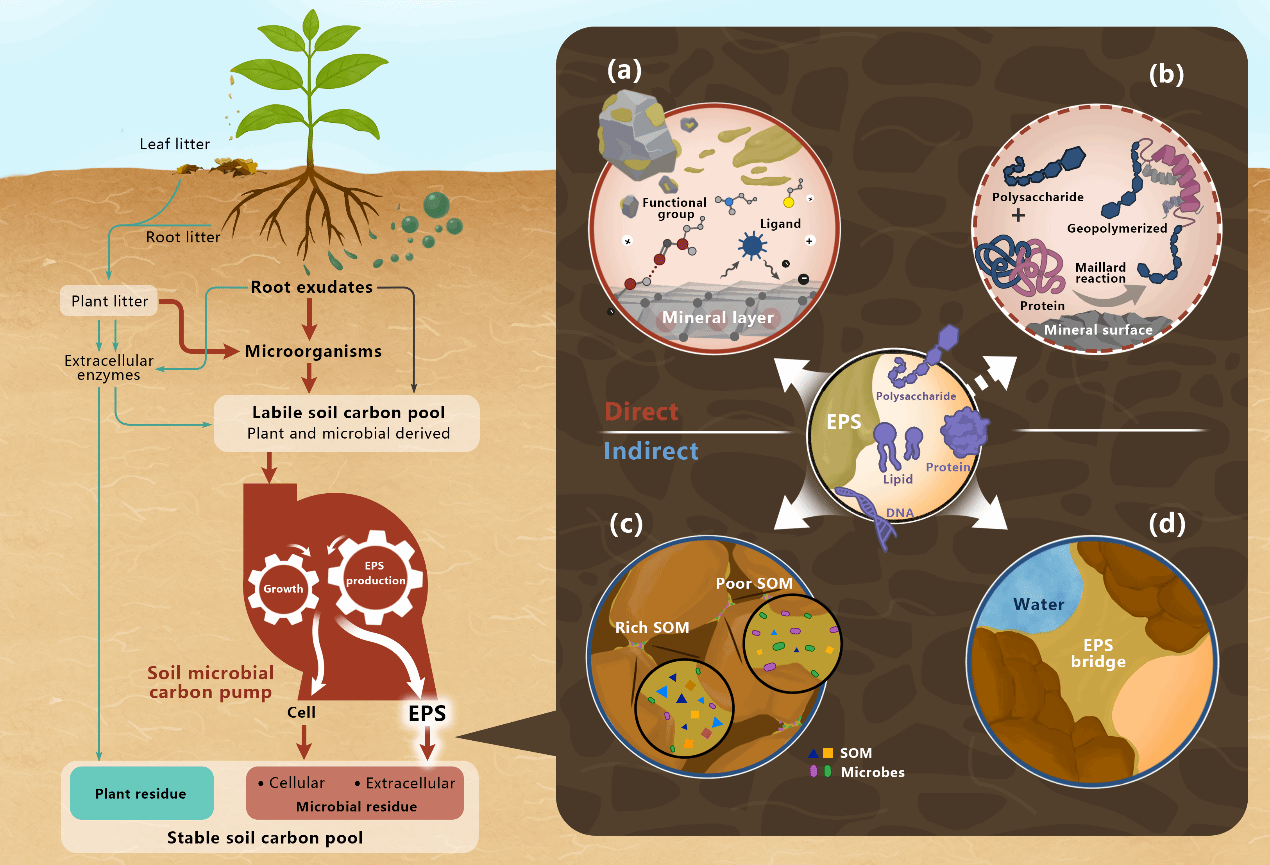
图1 土壤EPS的合成及其介导的土壤有机碳稳定机制
在此基础上,研究团队进一步拓展了土壤微生物碳泵理论,把EPS参与的“胞外碳封存”这条路径,创新性地纳入理论框架。原有框架把微生物驱动的土壤碳转化,概括为“体内周转”和“体外修饰”两条路径。其中,“体内周转”指植物产生的有机物被微生物吸收,转化成自身细胞,最终形成微生物残体的过程。本研究把“体内周转”进一步拆成两条路径:一条是形成微生物细胞的“胞内路径”;另一条是合成EPS的“胞外路径”。
这个新框架表明:微生物会根据自己的处境,在“制造细胞”和“制造EPS”之间分配资源,这会深刻影响土壤有机碳的多样性和稳定性。条件好、压力小的时候,微生物把更多碳用于自身生长;而在干旱、盐碱、重金属等压力变大时,微生物会更多地合成和分泌EPS,来增强自己的适应能力。由于EPS的化学成分更加多样,加强“胞外路径”,能让土壤有机碳的种类更多、更稳定。这项研究为理解微生物如何影响土壤碳汇提供了新视角,也为今后通过调节微生物的胞内外碳分配、改善土壤结构、提升农田土壤固碳能力,开辟了新的研究方向。
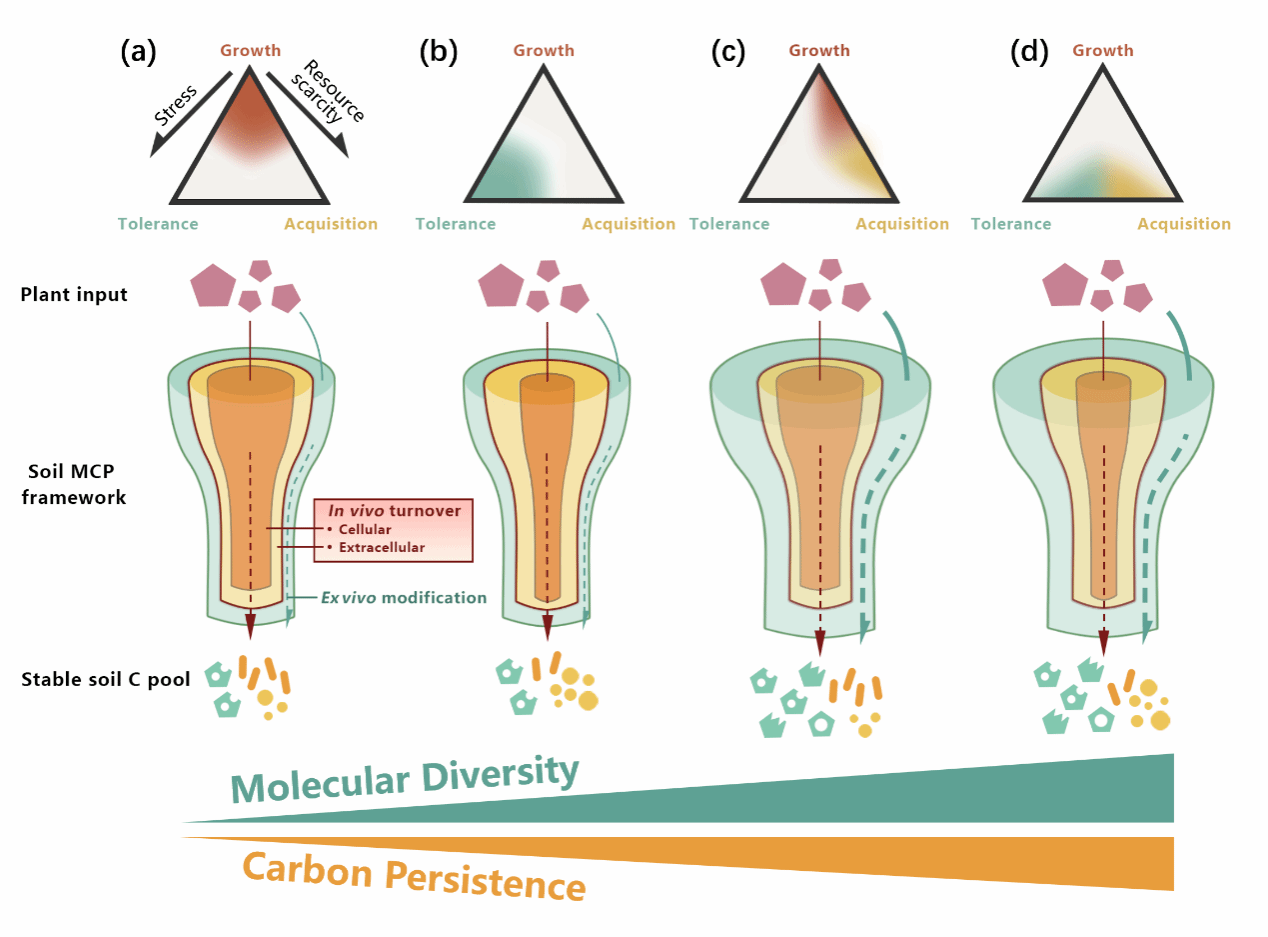
图2 纳入EPS胞外碳封存路径的土壤微生物碳泵理论框架
华中农业大学资源与环境学院、农业微生物资源发掘与利用全国重点实验室吴一超副研究员、易彧为硕士研究生为论文共同第一作者,蔡鹏教授与浙江农林大学梁超教授为论文共同通讯作者。本研究还与中国科学院生态环境研究中心、中国科学院海洋研究所、奥地利格拉茨大学、奥地利格拉茨工业大学、新加坡南洋理工大学等国内外科研机构开展合作探讨。本研究得到国家自然科学基金、中央高校基本科研业务费专项资金等项目资助。
论文链接:https://doi.org/10.1016/j.soilbio.2026.110299
英文摘要:
Microbial contributions to the persistence of soil organic carbon (SOC) are often attributed to the long-term accumulation of microbially derived products, primarily cellular residues. Beyond cellular products, microbes also synthesize and secrete a group of ubiquitous, adhesive macromolecules known as extracellular polymeric substances (EPS). Although the involvement of soil EPS in SOC persistence has long been suggested, their quantitative contribution and underlying mechanisms remain poorly resolved. In this review, we synthesize current knowledge to highlight that, although EPS quantified using existing methods account for approximately 2% of SOC, their production often matches or exceeds microbial cellular biomass production, indicating that EPS represent a major microbial carbon flux to soil. We outline four mechanisms by which EPS contribute to SOC stabilization: the direct formation of (i) mineral-associated organic matter and (ii) geopolymers through mineral-catalyzed Maillard-type reactions, and the indirect protection of SOC through (iii) enhanced soil aggregation and (iv) modification of soil pore structure to physically constrain decomposition. We propose that EPS-mediated stabilization represents an important, yet underrecognized, component of microbial control over SOC persistence and explicitly incorporate EPS into the soil microbial carbon pump (MCP) framework. This framework distinguishes the in vivo extracellular route of EPS production from the in vivo cellular route of biomass production, providing a process-based basis for developing testable hypotheses on how cellular and extracellular microbial carbon fluxes jointly regulate SOC formation and persistence. Key research priorities include developing robust approaches for soil EPS extraction and quantification, incorporating EPS dynamics into SOC models, and obtaining a mechanistic understanding of environmental and microbial controls on EPS production and degradation. Addressing these gaps will significantly refine our understanding of microbial contributions to the terrestrial carbon cycle and inform strategies to enhance soil carbon storage.




 最近新闻
最近新闻