南湖新闻网讯(通讯员 商祥明)近日,华中农业大学园艺林学学院、果蔬园艺作物种质创新与利用全国重点实验室、湖北洪山实验室刘继红教授、李春龙教授研究团队研究成果以“The regulatory cascade CtrMYC2-CtrMYB20-CtrSTP13 boosts sugar and JA accumulation for cold tolerance in Citrus”为题在The Plant Cell发表。研究揭示了低温下茉莉酸信号通过CtrMYC2-CtrMYB20-CtrSTP13级联反应促进己糖积累,进一步促进JA生物合成形成正反馈调节回路,从而显著提升枳(Citrus trifoliata)抗寒性的分子机制。
低温胁迫是限制全球农作物地理分布、生长发育及产量品质的重要非生物胁迫因子。柑橘作为起源于热带及亚热带的果树,对寒害极其敏感,严重冻害会导致树体受损甚至整株死亡。植物在长期进化过程中形成了有效的抵御低温机制,其中渗透调节物质(如可溶性糖)的积累和应激激素(如茉莉酸,Jasmonic Acid,JA)的信号转导发挥着核心作用。尽管已知JA和可溶性糖都能增强植物抗寒性,但JA如何介导糖分积累来应对低温,以及这两者之间是否存在协同作用,其分子机制仍有待深入发掘。
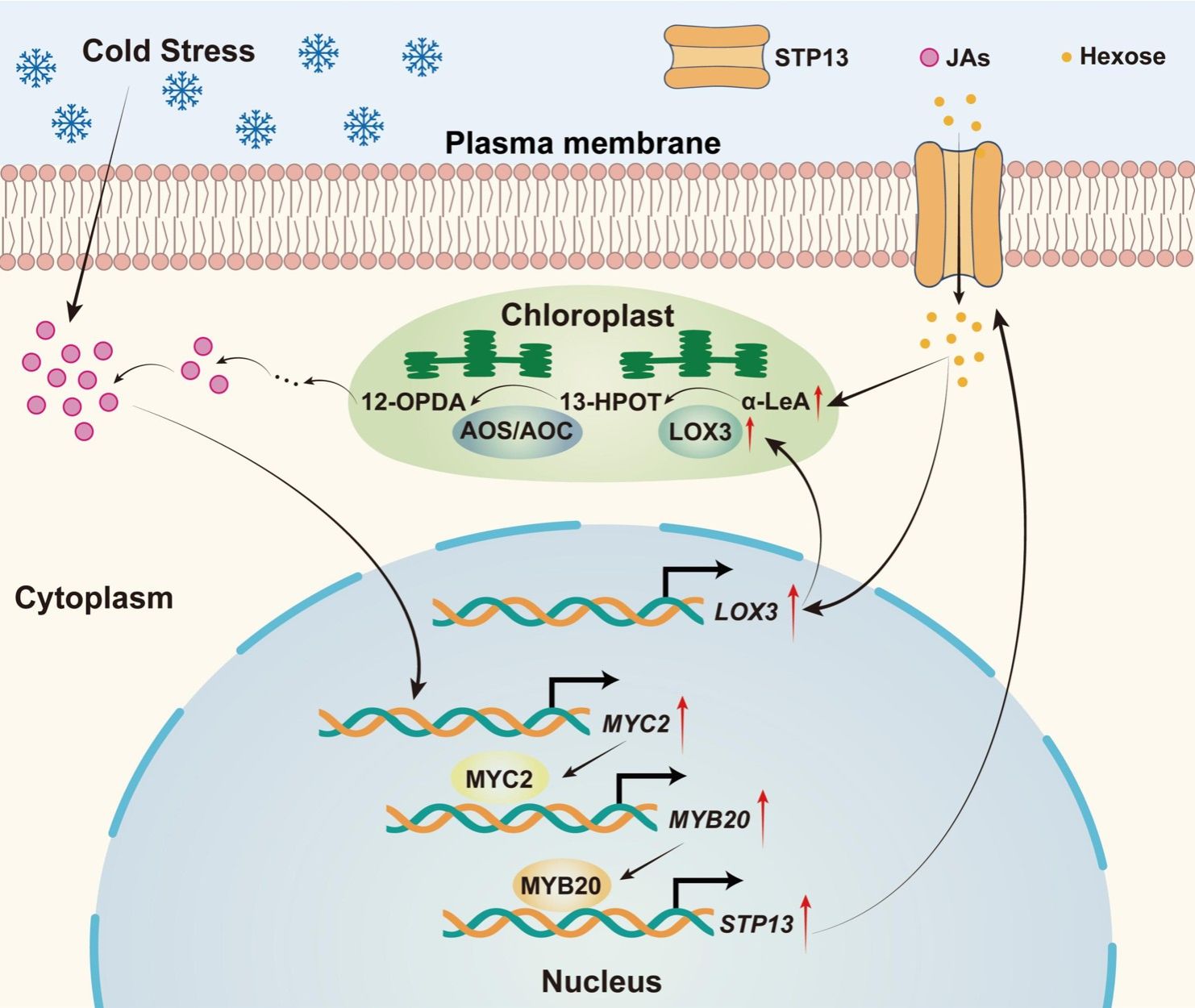
JA介导的CtrMYC2-CtrMYB20-CtrSTP13调控模块在柑橘耐寒性中的工作模型
研究团队通过对MeJA和低温处理下的枳植株转录组整合分析,鉴定出同时受两者诱导高表达的糖转运蛋白编码基因CtrSTP13。功能分析显示,CtrSTP13定位于质膜并在叶片中高表达,作为己糖转运蛋白通过促进糖分积累增强植株抗寒能力。在分子机制上,团队进一步发现转录因子CtrMYB20 作为CtrSTP13的上游正向调节因子参与抗寒应答过程;同时,JA信号通路的核心转录因子CtrMYC2,通过“CtrMYC2-CtrMYB20-CtrSTP13”转录级联反应间接促进糖积累,进而正向调控抗寒性。
尤为重要的是,研究揭示了一个“糖积累与JA合成”的正反馈调节环路:CtrSTP13介导的可溶性糖积累显著提升了 JA 合成前体 α-亚麻酸的水平,并上调了关键合成基因 CtrLOX3 的表达,从而增强JA 的生物合成;而沉默CtrSTP13则产生了相反的效果,并且敲低CtrLOX3则会阻断糖诱导的JA合成并削弱植株抗寒性。
综上所述,该研究阐明了JA信号通过转录级联促进低温下柑橘植株糖积累,而糖分又反馈增强JA生物合成,从而形成一个相互促进的调控环路以应对冷胁迫。该研究为深入理解植物整合激素信号与糖代谢积累以适应极端环境提供了新见解。
华中农业大学园艺林学学院、果蔬园艺作物种质创新与利用全国重点实验室、湖北洪山实验室刘继红教授、李春龙教授为论文共同通讯作者。华中农业大学园艺林学学院已毕业博士生商祥明为论文第一作者。该研究得到了国家重点研发计划项目、国家自然科学基金项目等项目资助。
论文链接:https://doi.org/10.1093/plcell/koag216
【英文摘要】
Jasmonic acid (JA) and soluble sugars are known to play critical roles in modulating cold tolerance in plants. However, the interplay between these signaling and metabolic pathways, as well as the transcriptional networks involved, remains poorly understood. In this study, we demonstrated that JA signaling was required for cold tolerance and for the cold-induced accumulation of soluble sugars in Citrus trifoliata. Integrated analyses of MeJA- and cold-treated transcriptomes identified CtrSTP13 as the most strongly induced sugar transporter gene under both conditions. CtrSTP13, localized to the plasma membrane and highly expressed in leaves, functioned as a hexose transporter for enhancing sugar accumulation and cold tolerance. We further revealed that the transcription factor CtrMYB20 was a direct positive regulator of CtrSTP13 expression, thereby controlling cold tolerance in a CtrSTP13-dependent manner. Additionally, CtrMYC2 acted as an upstream transcriptional activator of CtrMYB20 and positively regulated cold tolerance by indirectly promoting CtrSTP13-mediated sugar accumulation. Notably, overexpression of CtrSTP13 led to increased α-linolenic acid levels and upregulation of the JA biosynthetic gene CtrLOX3, and stimulated JA biosynthesis, whereas silencing CtrSTP13 produced opposite effects. Interestingly, knockdown of CtrLOX3 disrupted sugar-induced JA accumulation and impaired cold tolerance. Collectively, our results demonstrate that JA promotes cold-induced sugar accumulation through the transcriptional cascade CtrMYC2-CtrMYB20-CtrSTP13, while sugars feedback to enhance CtrLOX3-mediated JA biosynthesis, thereby establishing a regulatory loop that facilitates cold adaptation. These findings provide new insights into the elucidation of integrated JA signaling and sugar metabolism associated with plant cold stress responses.




 最近新闻
最近新闻