南湖新闻网讯(通讯员 扈晓碟) 近日,我校资源与环境学院史志华教授团队在Environmental Science & Technology发表了题为“Molecular Evidence from FT-ICR MS and Bayesian Mixing Model Reveals Hillslope Soils as Dominant DOM Contributors during Rainfall”的学术论文。
可溶性有机质是一类富含官能团的非均质有机混合物,其活性较强,可通过多种机制与有机污染物及重金属结合,从而改变污染物在水体中的吸附、解吸与迁移行为,进而影响水环境质量与人类健康。已有研究表明,水生生态系统中可溶性有机质的组分特征与反应活性在很大程度上取决于其来源变化。然而,传统研究方法难以在时空维度上精细化解析可溶性有机质的来源动态,制约了对可溶性有机质输移机制的深入理解。
研究团队将“高频采样→FT-ICR MS分子指纹→贝叶斯源解析”全链条联合应用于降雨过程可溶性有机质溯源。通过高频原位监测与采样,利用傅里叶变换离子回旋共振质谱与贝叶斯混合模型,系统分析了端元(雨水、地下水、河岸土壤和山坡土壤)与径流可溶性有机质的光学与分子特征,精准量化了降雨事件中径流可溶性有机质的来源动态。研究发现,土壤有机质以类腐殖质为主,而雨水富含类蛋白质,荧光指标变化趋势与之一致,表明雨水DOM具有明显的自生源特征,且腐殖化程度低于土壤和地下水。降雨过程中,山坡土壤对径流有机质的平均贡献高达49.2%,远超河岸土壤(30.3%)、地下水(13.1%)和雨水(7.5%)。值得注意的是,山坡土壤贡献率从降雨初期的42.4%攀升至流量峰值期的57.6%,此时有机质的芳香度与不饱和度也达到最高,表明陆源有机物大量输入。这一发现挑战了“河岸带主导河流有机质来源”的传统观点,凸显了山坡地水土保持对水质保护的重要性。面对未来极端降雨增多,在山坡推行免耕、覆盖种植等措施,或将成为调控流域碳输出的长效之策。
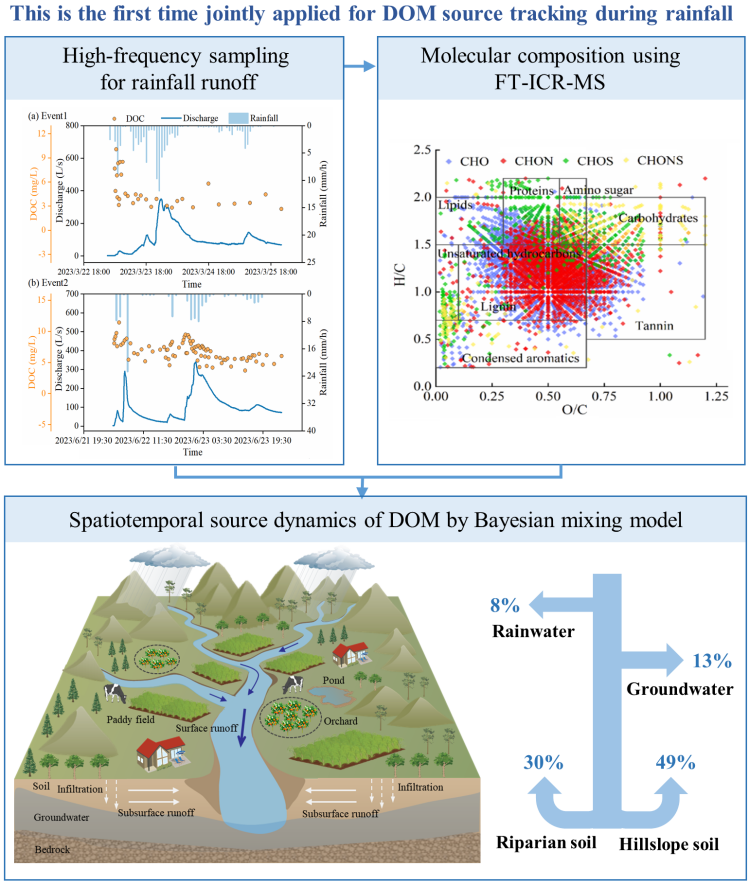
“高频采样→FT-ICR MS分子指纹→贝叶斯源解析”全链条联合应用于流域DOM溯源
博士研究生扈晓碟为论文的第一作者,肖海兵副教授和史志华教授为论文通讯作者。硕士生严婉莹、博士生马斯琳、赵劲松副教授、王剑副教授参与了研究。本研究得到了国家自然科学基金项目(批准号:U22A20611)的资助。
【英文摘要】
Rainfall-driven migration of dissolved organic matter (DOM) from various sources regulates terrestrial carbon cycling and pollutant fate, yet its spatiotemporal source dynamics remain unresolved due to methodological limitations. Here, we conducted high-frequency runoff sampling across 15 rainfall events, with potential DOM source samples including hillslope soil, riparian soil, groundwater, and rainwater. Fourier transform ion cyclotron resonance mass spectrometry (FT-ICR MS) was integrated with Bayesian mixing model to quantify source-specific DOM contributions at high temporal resolution. Results showed significantly higher humic-like component proportions in soil and groundwater than in rainwater, whereas rainwater had the highest protein-like component. Furthermore, DOM aromaticity and unsaturated degree in runoff reached maximum at peak discharge during rainfall, indicating the input of abundant terrestrial materials. Bayesian mixing model revealed soils as the dominant source of runoff DOM (49.2% hillslope soil and 30.3% riparian soil), followed by groundwater (13.1%) and rainwater (7.5%). Specifically, the average contribution of hillslope soil to runoff DOM increased from 42.4% to 57.6% during rainfall events, and the highest average proportion of riparian soil (35.6%) was observed at the beginning of rainfall. Our finding that hillslope soil is a key contributor to runoff DOM during rainfall underscores the need to prioritize upland management in catchment strategies.
原文链接:https://doi.org/10.1021/acs.est.6c02514
审核人:肖海兵




 最近新闻
最近新闻