南湖新闻网讯(通讯员 褚楚) 近日,华中农业大学动物科学技术学院、动物医学院农业动物遗传育种与繁殖教育部重点实验室张淑君教授团队在奶牛繁殖力检测领域取得进展,相关系列成果分别以“Use of early-lactation milk Fourier-transform mid-infrared spectroscopy and farm data to predict the calving-to-conception interval in Chinese dairy cows”和“Prediction of the likelihood of conception after the first or second insemination in Chinese Holstein cows using milk Fourier-transform infrared spectroscopy”为题在Journal of Dairy Science期刊上发表。两项研究从不同角度出发,共同为在泌乳早期预测奶牛繁殖力提供了新的方法。
奶牛场的经济效益很大程度上取决于奶牛泌乳早期能否成功受孕。高繁奶牛通常在产犊后不久即可恢复卵巢功能,并在适当授精后成功受孕。相反,低繁奶牛要到泌乳中期或后期才能受孕,甚至一直不受孕。奶牛产犊至受孕间隔(calving-to-conception interval, CCI)越长、受孕时所需的配种次数(the number of services per conception, NSC)越多,牧场的经济损失越大。如果能在奶牛配种期开始前(泌乳早期)快速、准确、低成本地检测出单头奶牛繁殖力高低,就能帮助牧场作出合理、有针对性的繁殖计划安排,如性别控制精液的使用、兽医治疗、奶牛的淘汰及饲养管理方案的调整等。
中红外光谱(Mid-infrared spectroscopy, MIRS)技术基于电磁辐射与物质之间的相互作用,是一种快速、高通量、低成本和环境友好的分析工具,已广泛应用于奶牛生产性能测定计划中,用于量化牛奶中的常规成分含量,如乳脂、乳蛋白、乳糖、尿素氮和总固形物。在全球,实施奶牛生产性能测定计划是优化牛群性能、培育高产核心群的关键手段。该计划能系统性地获取大量单头奶牛的表型数据,为精准畜牧养殖、牛群管理计划调整、奶牛遗传评估、牛奶质量监测奠定坚实基础。目前,由于缺少相关的预测模型,繁殖力监测一直未被纳入中国的奶牛生产性能测定体系。
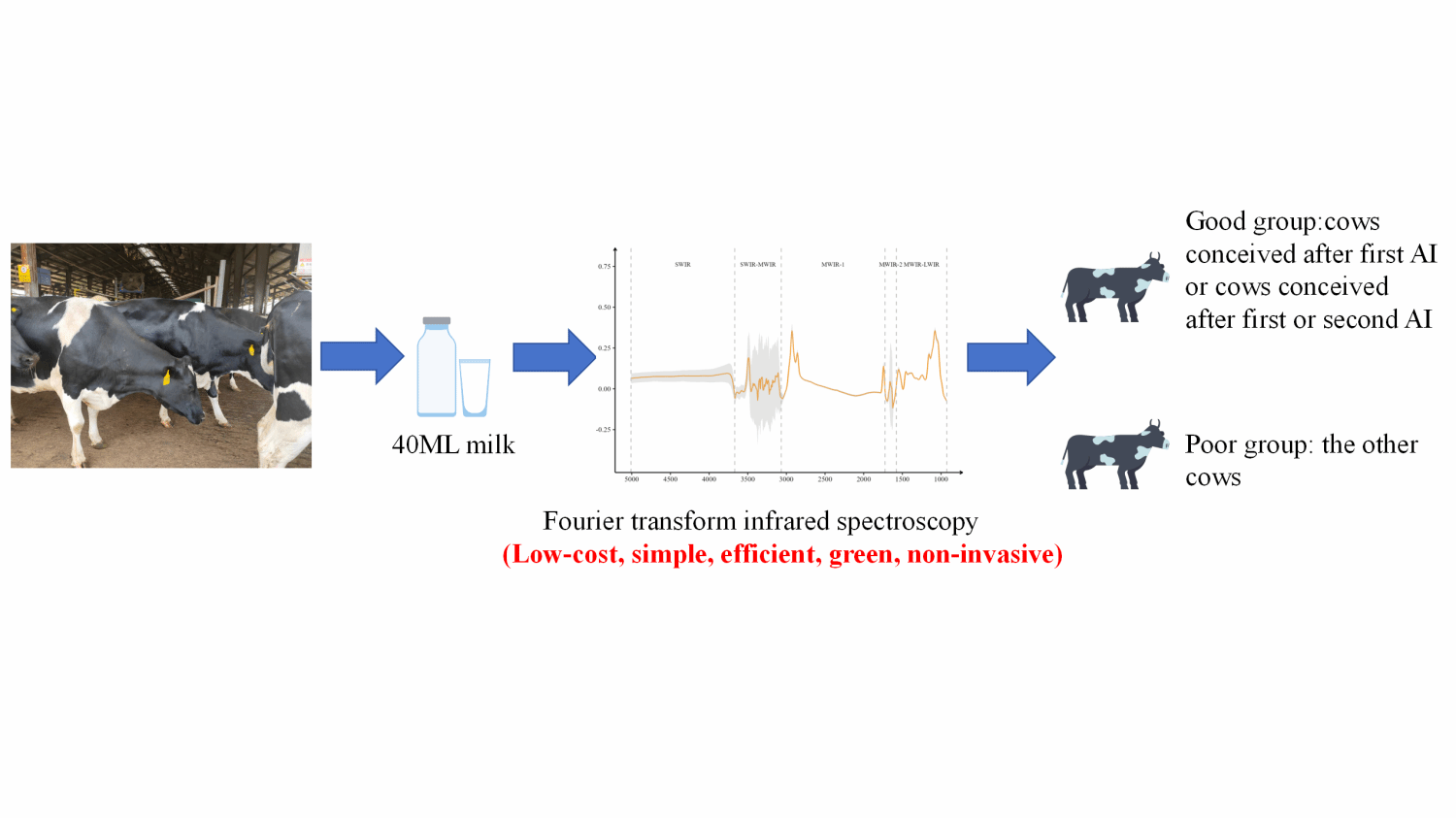
图1 利用光谱预测奶牛繁殖力
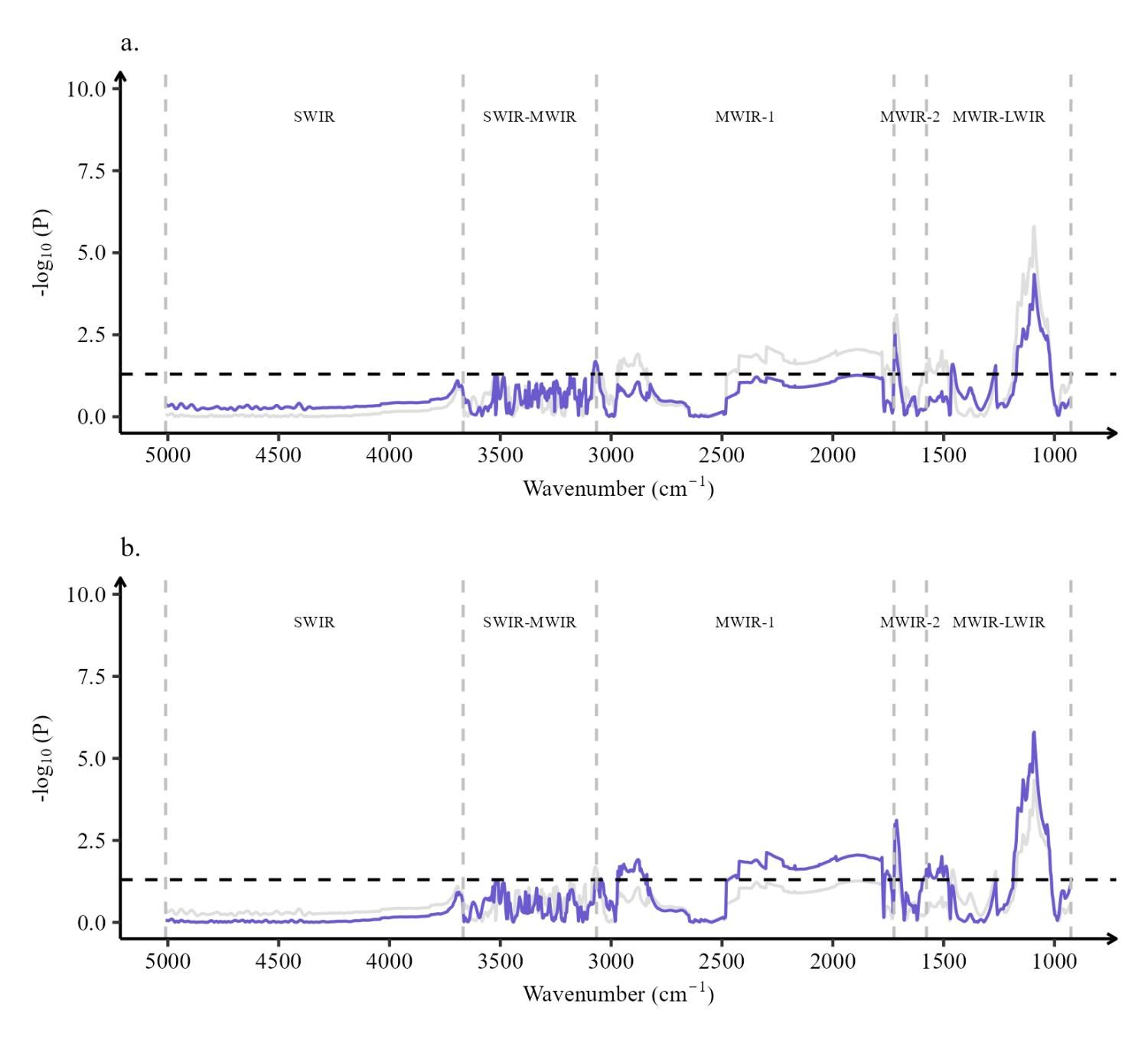
图2 奶牛繁殖力对中红外光谱的影响
针对这一空白,本系列研究基于奶牛配种期开始前收集的牛奶MIRS和奶牛个体数据(如胎次、泌乳阶段和产奶量等),建立了两个从不同角度预测奶牛繁殖力高低的分类模型。“CCI模型”(基于第一篇研究)用于鉴别奶牛在产犊后90天或150天内能否受孕;“NSC模型”(基于第二篇研究)用于鉴别奶牛经过少次配种后能否受孕。团队提出,可将这两个模型结合使用,共同作为决策支持工具,在配种期开始前为牧场提供一份奶牛未来繁殖潜力的清单。
模型经过进一步优化后可纳入中国奶牛生产性能测定体系中,从而实现对奶牛繁殖力高低的快速、低成本、高效、准确的监测。这标志着将繁殖力监测纳入我国现有奶牛生产性能测定体系已成为可能,对推动精准畜牧养殖发展具有重要意义。此外,研究还确定了预测奶牛繁殖力高低的最佳时间窗口(即产后22至30天),从而有助于确定利用光谱数据进行牧场繁殖管理决策的最佳采样时间。
我校动物科学技术学院、动物医学院博士生褚楚为文章第一作者,张淑君教授为通讯作者,河北省畜牧良种工作站倪俊卿、马亚宾、李建明,宁夏回族自治区畜牧工作站温万、王琨、李委奇等为共同作者。本研究得到国家重点研发计划和中央高校基本科研业务费专项基金等项目的资助。
论文链接1:https://doi.org/10.3168/jds.2025-26495
英文摘要:
The potential of milk Fourier-transform mid-infrared (FTIR) spectroscopy in predicting cow fertility has been extensively examined, but largely based on the number of services per conception (NSC). Compared with NSC, Calving-to-conception interval (CCI) may be a more critical factor influencing the profitability, productivity, and sustainability of dairy herds, as it reflects days to first breeding, voluntary waiting period, NSC, and service intervals. Our objectives were to evaluate the ability of FTIR spectroscopy and farm data collected from early lactation to predict CCI length postcalving in Holstein cows from a highly productive TMR system. We also sought to identify the most informative milk sampling periods for CCI prediction. From January 2019 to December 2023, FTIR spectra records, cow information, milk recording information, and fertility information were collected from 28,434 Holstein cows within 13 dairy farms in China. First, cows were classified into long calving-to-conception interval (LCCI) and short calving-to-conception interval (SCCI) groups based on 2 strategies. Strategy 1 defined LCCI as cows with a CCI longer than 150 d and SCCI as cows with a CCI shorter than 150 d. Strategy 2 employed a similar method but with a CCI threshold of 90 d. Second, partial least squares discriminant analysis was employed to develop prediction models for the classification of LCCI and SCCI cows. The performance of models was assessed using herd-independent cross-validation. These analyses were conducted separately for the complete dataset as well as for each of the 9 subsets stratified based on postcalving time windows. The results showed that the area under the receiver operating characteristic curve of cross-validation (AUCCV) varied from 0.461 to 0.675 across different predictors, strategies, and time windows. Across all strategies, prediction accuracy was highest for models developed using data from time windows 22 to 30 days postpartum (dpp) and >60 dpp. The classification model, developed using standard normal variate preprocessed spectra, cow information, milk yield, SCS, and fat-to-protein ratio (FPR) data collected from the time window 22 to 30 dpp, demonstrated the best performance in strategy 1. The values of AUCCV, sensitivity of cross-validation (SENSCV), and specificity of cross-validation (SPECCV) were 0.650, 0.519, and 0.706, respectively. The best-performing classification model based on strategy 2 was developed using Savitzky–Golay preprocessed spectra, cow information, milk yield, SCS, and FPR data collected from the time window >60 dpp, with AUCCV, SENSCV, and SPECCV values of 0.675, 0.552, and 0.712, respectively. In conclusion, FTIR and farm data collected from early lactation could distinguish between cows with different CCI lengths with moderate accuracy. The time window 22 to 30 dpp could provide more effective and accurate predictions for the future fertility of dairy cows, and its use and implementation should be considered in practical farm production. Our study highlights the future application of high-throughput phenotyping technologies in precision livestock farming and offers novel insights into alternate methods for assessing cow fertility.
论文链接2:https://doi.org/10.3168/jds.2024-25269
英文摘要:
Accurate identification of cows' likelihood of conception during the period from recent calving to the first artificial insemination (AI) will provide assistance in managing the fertility of dairy cows and contribute to the economic prosperity and sustainability of farms. The purpose of this study was to use Fourier-transform infrared (FTIR) spectroscopy data collected between recent calving and the first AI to predict the likelihood of a cow conceiving after the first AI and the first or second AI. This study specifically focused on the role of FTIR spectral and farm data collected during different time windows in improving the accuracy of models for predicting a cow's likelihood of conceiving after the first AI and the first or second AI. From 2019 to 2023, fertility information of 10,873 Holstein dairy cows in China were collected, coupled with 21,928 spectral data. First, cows were classified as having a good or poor likelihood of conception. In strategy 1, cows conceiving after the first AI were classified as having a good likelihood of conception and as others as having a poor likelihood of conception. In strategy 2, cows conceiving after the first or second AI were classified as having a good likelihood of conception and others as having a poor likelihood of conception. Second, partial least squares discriminant analysis was used to develop models for predicting the likelihood of conception after the first AI and the first or second AI. The model was assessed using a cross-validation set and herd-independent external validation set. The study also focused on examining the potential correlation between the accuracy of prediction and the period of spectral and farm data collection by analyzing the diagnostic performance of the model in 8 different time windows: from 0 to 7 d postpartum (dpp), 8 to 14 dpp, 15 to 21 dpp, 22 to 30 dpp, 31 to 45 dpp, 46 to 60 dpp, ≥61 dpp, and 0 to 7 d before the first AI. The results showed that the model based on strategy 1 performed better when in proximity to the first AI, with AUC for the cross-validation and herd-independent external validation sets of 0.621 and 0.633, respectively. The model based on strategy 2 exhibited superior performance throughout the late phase of uterine involution. The optimal model was developed by using spectral data collected from 22 to 30 dpp. The AUC for the cross-validation and herd-independent external validation sets were 0.644 and 0.660, respectively, which were higher than those of strategy 1. This study demonstrates the potential of using FTIR spectral data to predict a cow's ability to conceive. The model developed from data collected within a certain time window exhibited better prediction accuracy, particularly from 22 to 30 dpp and 0 to 7 d before the first AI. This study offers novel perspectives on alternate approaches for assessing the fertility of cows, which will contribute to the regularization and sustainability of farms, as well as to the precision management of agriculture.
审核人:张淑君




 最近新闻
最近新闻